Tell it what your week looks like
Add your goal, experience, schedule, equipment and the time you can genuinely train.

A plan only earns the word adaptive if completed sessions can influence later decisions. GRITFIT starts with your goal, equipment and schedule, then brings the work you log back into the planning process.
The setup tells the app where you are starting. Your training log shows what really happened. Both are needed before a later recommendation can make sense.
Add your goal, experience, schedule, equipment and the time you can genuinely train.
Follow a workout or programme with clear sets, reps, load, duration or intervals.
Record what you completed, how hard it felt and any feedback worth carrying forward.
Use that training history when preparing the next recommendation, with important changes still checked and confirmed.
You may have an hour on Monday, 25 minutes on Thursday and no chance of getting near the squat rack on Saturday. GRITFIT keeps those changes near the plan instead of treating every workout as a blank page.
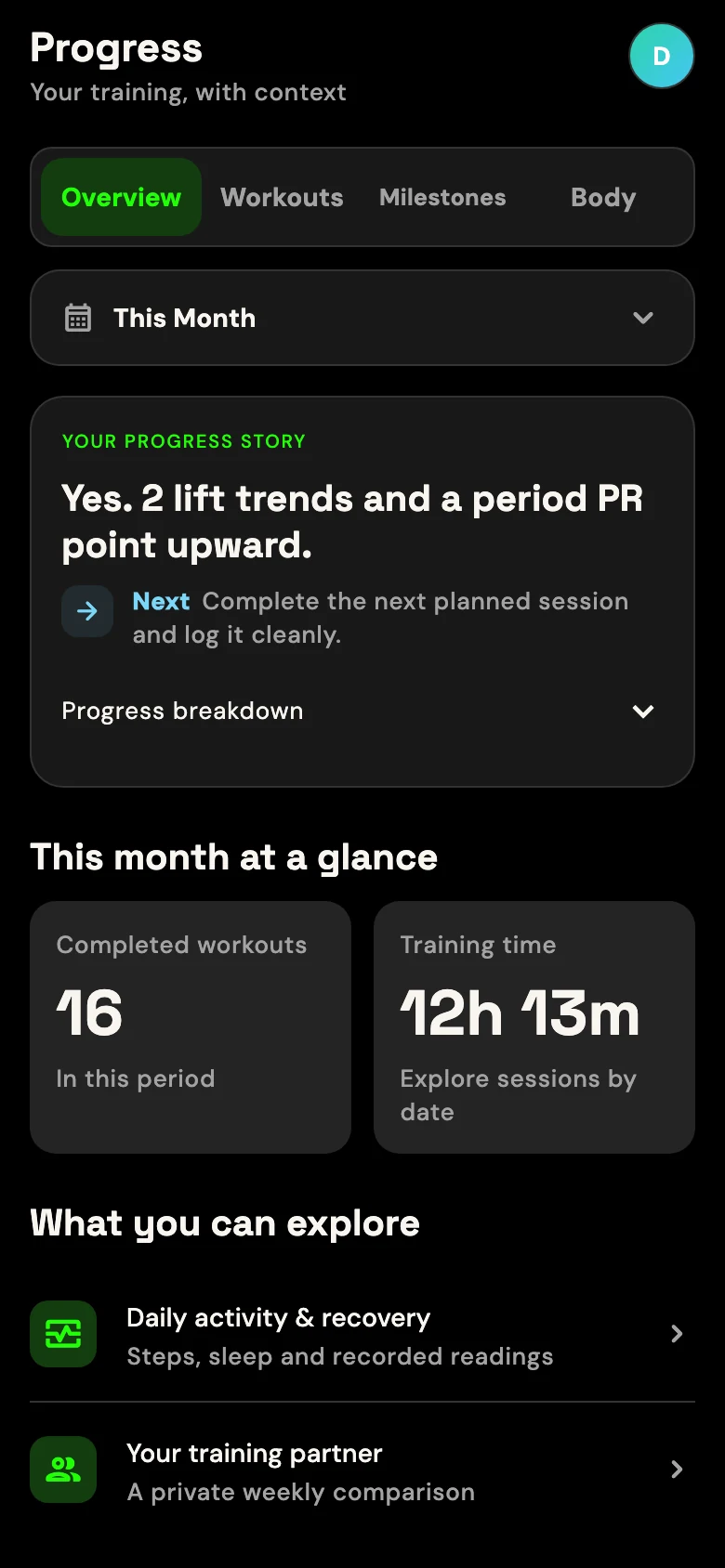
A plan can be personalised without changing after you begin. Adaptation is the continuing connection between your inputs, recorded work and later recommendations.
| Planning approach | Starting information | Recorded training | Later recommendations |
|---|---|---|---|
| Static workout plan | General assumptions | Usually separate | Follows the original schedule |
| Personalised workout plan | Tailored at setup | Varies by product | May remain fixed |
| GRITFIT adaptive planner | Your goals, schedule and equipment | Training log | Training history can influence the next plan |
GRITFIT is in private beta. Features can change, and an adaptive recommendation is not a guarantee of results or a substitute for professional judgement.
Strength, steady cardio and intervals ask different questions. Their recording screens and progression logic should reflect that.
Follow and record sets, reps, load, effort and completion while keeping each exercise connected to its history.
Plan and record duration, distance and effort without forcing cardio into a strength-workout template.
Use rounds, work periods and rest periods in a session format designed for the clock.
Or 317.73 million when the choice of training weekdays is included. That is before event dates, restrictions, training history and custom goal text add further context.
These figures count theoretical combinations of setup choices, not unique workouts, tested plans or estimated failures. Some combinations overlap or are incompatible; not every combination has been validated. More choices only help when the resulting plan has a clear structure and fits the person using it.
Based on the onboarding options reviewed on 4 September 2026: 29 built-in goals, 6 experience levels, 5 weekly frequencies, 5 session durations, 3 locations and 1,023 non-empty selections from 10 equipment options.
29 × 6 × 5 × 5 × 3 × 1,023 = 13,350,150 raw configurations, rounded to 13.35 million.
There are 119 ways to choose 2 to 6 training weekdays from a seven-day week. Replacing the 5 frequency choices with those 119 weekday selections gives 29 × 6 × 119 × 5 × 3 × 1,023 = 317,733,570, rounded to 317.73 million. These are alternative totals, not numbers to add together.
This calculation does not filter out equivalent or incompatible inputs and is not evidence that every configuration produces a suitable plan. Event dates, restrictions, training history and custom text are excluded from both totals.
An adaptive workout planner starts with your goals and circumstances, then checks later sessions against the training you complete. The point is to connect the plan and the log rather than repeatedly generating isolated workouts.
A personalised plan can be tailored once around your starting information. An adaptive plan revisits the decision after you log the work. Personalised describes the starting fit; adaptive describes what happens next.
Time, equipment, location and schedule can be used when preparing a new workout or programme. Coach can help build a session around changed circumstances, although edits to an already confirmed live session are intentionally more limited.
You can record limitations and recovery constraints so they can be considered during filtering and validation, but GRITFIT is not a diagnostic, treatment or rehabilitation service. Injury and return-to-training decisions may require assessment by a qualified professional.
No. An app cannot provide live observation, technique correction, human accountability or the judgement of a good trainer. See our honest comparison of an AI personal trainer app and a real PT.
GRITFIT is currently available through a limited private beta for compatible iPhones and iPads running iOS or iPadOS 15.0 or later, and Android devices running Android 8.0 Oreo (API level 26) or later.
Use it when the week shifts, then tell me where the plan stops being helpful.