
By Dan Eldridge, Founder of GRITFIT.AI
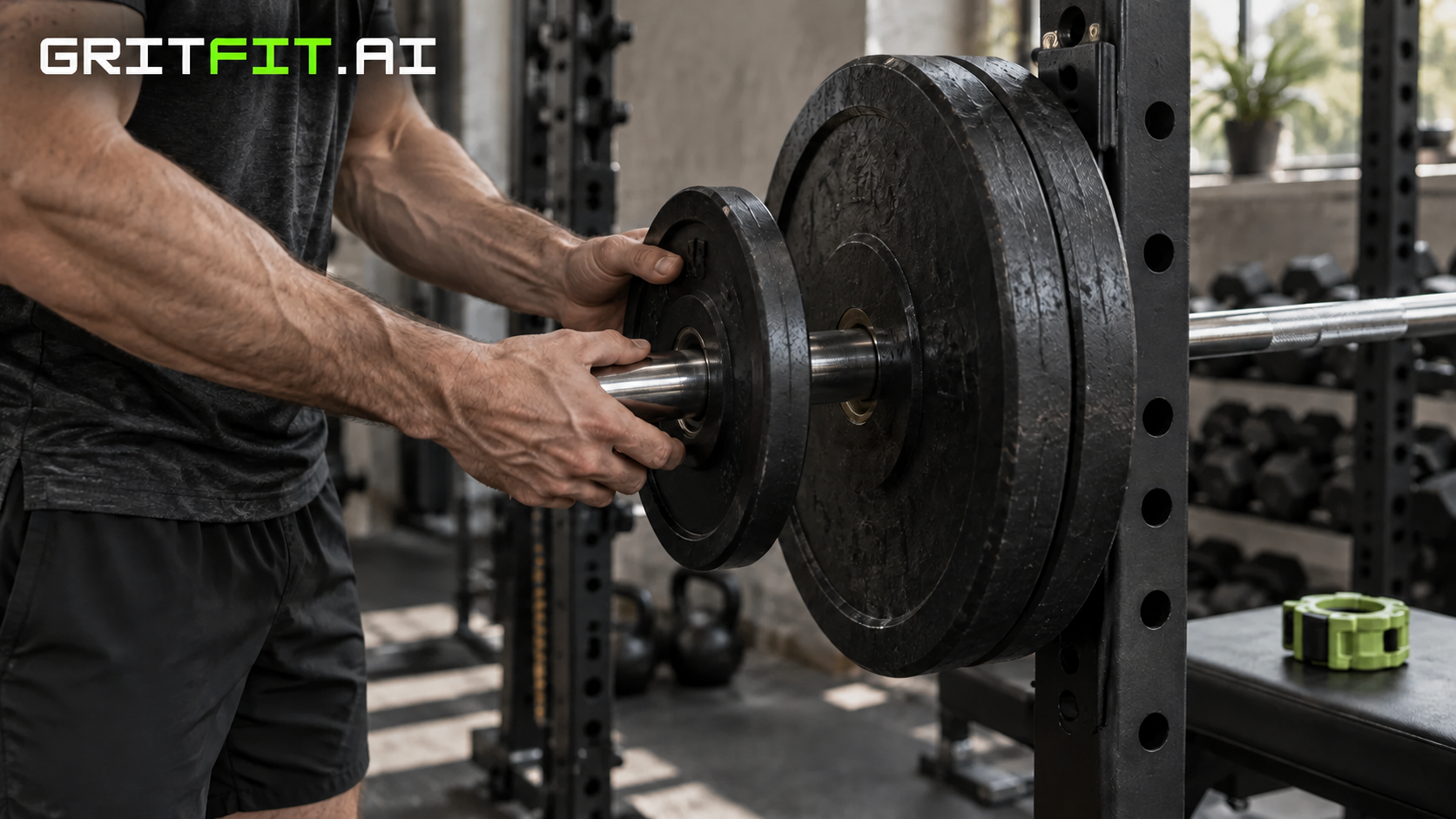
You’ve finished your three sets. The weight felt manageable. Do you go heavier next time, or stick with it?
I’d look at the whole exercise before deciding. What did you lift? How many reps did you manage on each set? Did you keep the movement controlled all the way through?
Those answers give you a sensible starting point for the next session.
Progress can come through repetitions
Progressive overload means gradually increasing the demand of training as your capacity develops. Adding weight is one option. Building repetitions at the same weight is another.
An eight-week study in adults who already strength trained found that increasing repetitions or load could both improve lower-body muscular adaptations. It gives us more than one way to progress; it doesn’t establish a fixed timetable for everyone. Plotkin and colleagues
For your own sessions, I’d choose a way to progress that you can record and repeat.
Work through your rep range
Suppose your programme uses three working sets of eight to twelve repetitions on a familiar exercise. Here’s a hypothetical cable-row log, assuming the machine offers these weight increments:
| Session | Weight | Reps across three sets |
|---|---|---|
| First visit | 40 kg | 10, 9, 8 |
| Later visit | 40 kg | 11, 10, 9 |
| Later visit | 40 kg | 12, 12, 12 |
| After a small increase | 42.5 kg | 9, 8, 8 |
At ten, nine and eight reps, there’s room to build within that range. When you’re consistently reaching twelve across the sets with controlled movement and the effort your programme calls for, you can consider a small increase. Your repetitions may then drop towards the lower end.
Those visits might be several weeks apart. Follow your programme’s progression rules, and use an increment you can manage. If the next jump takes you below your planned range or changes the movement substantially, it may be too much for now.
Compare the same exercise
Keep the comparison useful. Use the same exercise variation, a similar setup and roughly the same rest between sets. Record any changes. Twelve repetitions on a different machine may not mean the same thing as twelve on your usual one.
I’d log the weight, reps for each set and a quick note on how difficult it felt. A note such as “different machine” or “stopped early” can explain a lot when you look back.
You need enough detail to make the next decision. A few useful numbers and a short note will usually do.
Let your goal guide the increase
Your goal matters here. A review of studies where sets were taken to voluntary failure found similar muscle growth across different loads, while heavier loading generally produced greater gains in maximum strength. That distinction helps explain why programmes use different approaches. Lopez and colleagues
ACSM’s 2026 guidance emphasises tailoring training to the person and their goals. If you’re learning a movement, I’d put time into a repeatable setup and technique before chasing a bigger number. ACSM guidance
Know when to hold the weight steady
A difficult session is a reason to check the context. Have you returned after a break? Changed the exercise order? Had less rest between sets? Keep the weight steady when that is the useful next step. You don’t need to force an increase every week.
If an exercise causes pain, stop and seek appropriate advice. Adding weight won’t resolve it.
This is why I want GRITFIT to keep your completed training and your feedback together. A recommendation to go heavier should have a reason behind it. You can find out more about GRITFIT.
What do you currently check before going heavier?